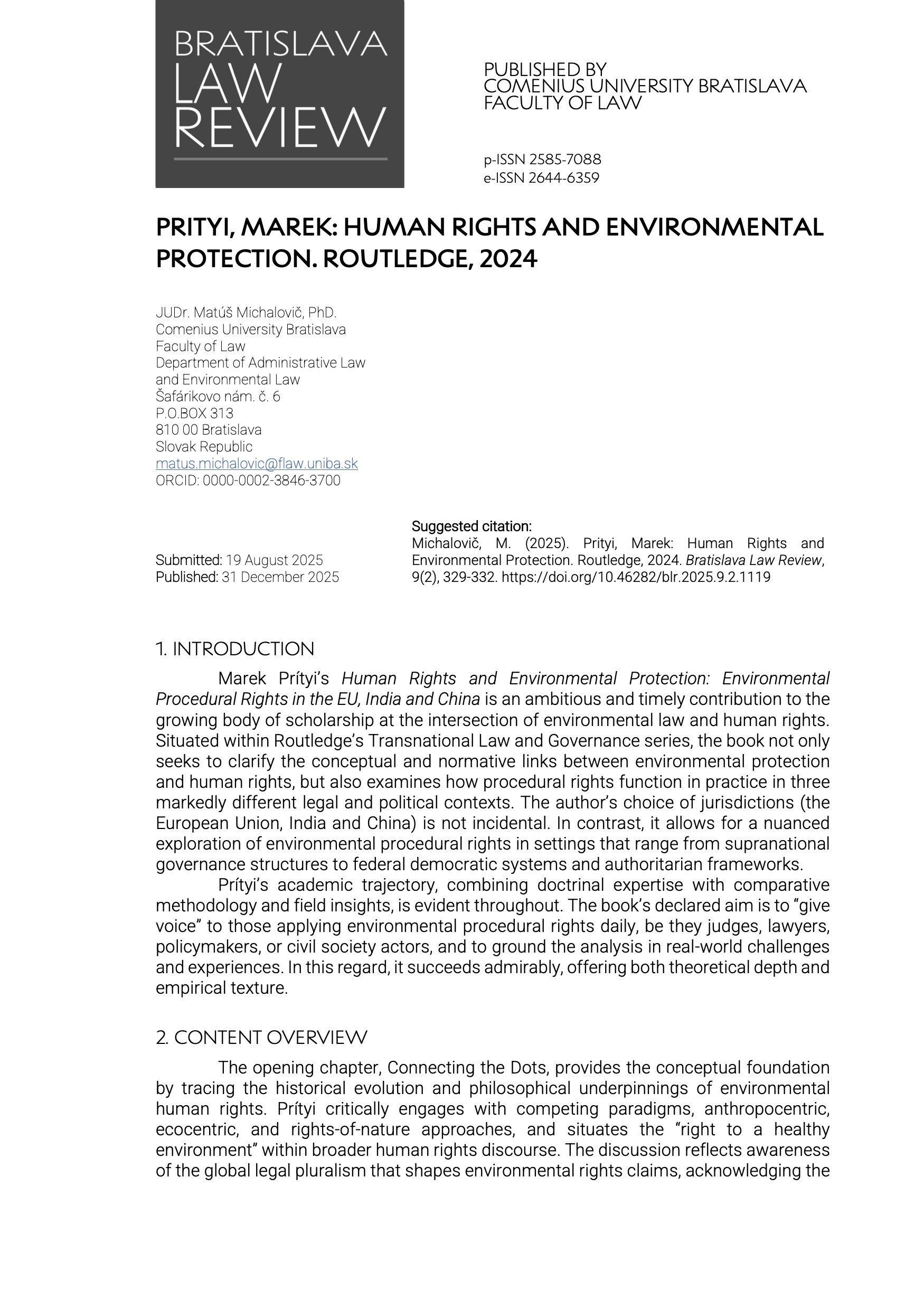
Prityi, Marek: Human Rights and Environmental Protection
Routledge, 2024
DOI:
https://doi.org/10.46282/blr.2025.9.2.1119Keywords:
Environmental protection, Human rights, Marek Prítyi, Human Rights and Environmental ProtectionAbstract
This review examines Marek Prítyi’s Human Rights and Environmental Protection: Environmental Procedural Rights in the EU, India and China, published within Routledge’s Transnational Law and Governance series. The book offers a rigorous and timely contribution to the scholarship on the intersection of human rights and environmental protection, with a focus on procedural rights across three distinct legal and political systems. Its comparative breadth, methodological transparency, and ability to link conceptual debates with empirical practice stand out as major strengths. By analysing the EU, India, and China side by side, Prítyi provides a nuanced understanding of how environmental procedural rights function in democratic, supranational, and authoritarian contexts. The review highlights the book’s capacity to bridge theory and practice, making it relevant to both academics and practitioners. At the same time, it notes that future editions could integrate a deeper engagement with the substantive right to a healthy environment, as well as the role of digital participation tools. Overall, the book is assessed as a well-executed, influential contribution that sets a benchmark for comparative scholarship on environmental human rights, while leaving space for further enrichment in subsequent editions.
References
Downloads
Published
Issue
Section
Categories
License
Copyright (c) 2026 Bratislava Law Review

This work is licensed under a Creative Commons Attribution-NonCommercial-NoDerivatives 4.0 International License.
The Author(s) transfers copyright to the Article to the Publisher of the Journal by the Licence Agreement.
The Author(s) retains rights specified in the Licence Agreement.
The readers may read, download, copy, distribute, print, search, or link to the full texts of all of the Article of the Journal and use them for any other lawful purpose under specified Creative Commons Licence (CC BY-NC-ND 4.0).