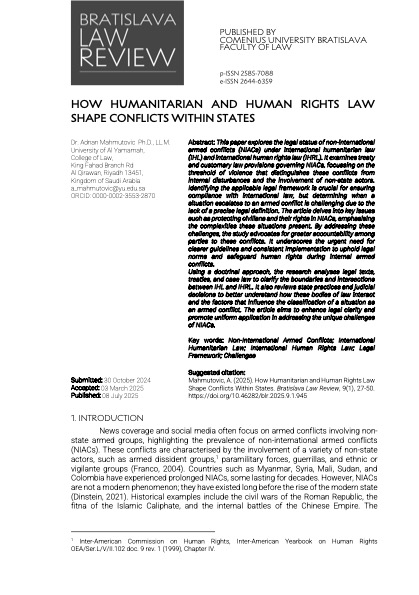
How Humanitarian and Human Rights Law Shape Conflicts Within States
DOI:
https://doi.org/10.46282/blr.2025.9.1.945Keywords:
Non-International Armed Conflicts, International Humanitarian Law, International Human Rights Law, Legal Framework, ChallengesAbstract
This paper explores the legal status of non-international armed conflicts (NIACs) under international humanitarian law (IHL) and international human rights law (IHRL). It examines treaty and customary law provisions governing NIACs, focussing on the threshold of violence that distinguishes these conflicts from internal disturbances and the involvement of non-state actors. Identifying the applicable legal framework is crucial for ensuring compliance with international law, but determining when a situation escalates to an armed conflict is challenging due to the lack of a precise legal definition. The article delves into key issues such as protecting civilians and their rights in NIACs, emphasising the complexities these situations present. By addressing these challenges, the study advocates for greater accountability among parties to these conflicts. It underscores the urgent need for clearer guidelines and consistent implementation to uphold legal norms and safeguard human rights during internal armed conflicts.
Using a doctrinal approach, the research analyses legal texts, treaties, and case law to clarify the boundaries and intersections between IHL and IHRL. It also reviews state practices and judicial decisions to better understand how these bodies of law interact and the factors that influence the classification of a situation as an armed conflict. The article aims to enhance legal clarity and promote uniform application in addressing the unique challenges of NIACs.
References
Abboud, N. S. (2016). Conflict, Governance, and Decentralized Authority in Syria. In: Martin Beck, M., Jung, D. and Seeberg, P. (ed.), The Levant in Turmoil: The Modern Muslim World. New York: Palgrave Macmillan. https://doi.org/10.1057/9781137526021_4 DOI: https://doi.org/10.1057/9781137526021_4
Arajärvi, N. J. (2011). Between Lex Lata and Lex Ferenda? Customary International (Criminal) Law and the Principle of Legality. Tilburg Law Review, 15(2), 163-183, https://doi.org/10.2139/ssrn.1968443 DOI: https://doi.org/10.1163/22112596-90000011
Ashri, M. (2019). Reconciliation of Humanitarian Law and Human Rights Law in Armed Conflict. Hasanuddin Law Review, 5(2), 209-219, https://doi.org/10.20956/halrev.v5i2.1348 DOI: https://doi.org/10.20956/halrev.v5i2.1348
Blank, R. L. and Corn, G. S. (2013). Losing The Forest For The Trees: Syria, Law, And The Pragmatics Of Conflict Recognition. Vanderbilt Journal of Transnational Law, 46, 693-725.
Blaustein, A., Clark, R. and Sigler, J. (1987). Human Rights Sourcebook. New York: Paragon House.
Bradley, M. M. (2017). Expanding the Borders of Common Article 3 in Non-International Armed Conflicts Amending Its Geographical Application Through Subsequent Practice?. Netherlands international law review, 64(3), 375-406. DOI: https://doi.org/10.1007/s40802-017-0100-7
Cassimatis, E. A. (2007). International Humanitarian Law, International Human Rights Law, and Fragmentation of International Law. International and Comparative Law Quarterly, 56(3) 623–639, https://doi.org/10.1093/iclq/lei185 DOI: https://doi.org/10.1093/iclq/lei185
Cerna, M. C. (1989). Human Rights in Armed Conflict: Implementation of International Humanitarian Law Norms by Regional Intergovernmental Human Rights Bodies. In: Kalshoven, F. and Sandoz, Y. (eds.), Implementation of International Humanitarian Law. Leiden: Martinus Nijhoff. DOI: https://doi.org/10.1163/9789004642393_005
Crawford, E. (2008). Blurring the Lines Between International and Non-International Armed Conflicts: The Evolution of Customary International Law Applicable in Internal Armed Conflicts. Australian International Law Journal, 15, 29–45.
Crawford, E. (2010). The Treatment of Combatants and Insurgents under the Law of Armed Conflict. Oxford: Oxford University Press. https://doi.org/10.1093/acprof:oso/9780199578962.001.0001 DOI: https://doi.org/10.1093/acprof:oso/9780199578962.001.0001
Crawford, E. (2012). Road to Nowhere? The Future for a Declaration on Fundamental Standards of Humanity. Journal of International Humanitarian Legal Studies, 3(1), 43-72. DOI: https://doi.org/10.1163/18781527-00301002
Dinstein, Y. (1986). Human Rights in Armed Conflict: International Humanitarian Law. In: Meron, T. (ed.), Human Rights in International Law: Legal and Policy Issues. Oxford: Oxford University Press. https://doi.org/10.1093/acprof:oso/9780198255406.003.0009 DOI: https://doi.org/10.1093/acprof:oso/9780198255406.003.0009
Dinstein, Y. (2005). War, Aggression, and Self-Defence. 4th edition. Cambridge: Cambridge University Press. DOI: https://doi.org/10.1017/CBO9780511841019
Dinstein, Y. (2021). Non-international Armed Conflicts in International Law. 2nd edition. Cambridge: Cambridge University Press. DOI: https://doi.org/10.1017/9781108864091
Dinstein, Y. and Dahl, W. A. (2020). Section XVI: Natural Environment. In: Dinstein, Y. and Dahl, W. A. (eds.), Oslo Manual on Select Topics of the Law of Armed Conflict. Cham: Springer. https://doi.org/10.1007/978-3-030-39169-0_16 DOI: https://doi.org/10.1007/978-3-030-39169-0
Droege, C. and Durham, H. (2021). Civilian Protection in Armed Conflict. In: Robin Geiß, R. and Melzer, N. (eds.), The Oxford Handbook of the International Law of Global Security. Oxford: OUP. DOI: https://doi.org/10.1093/law/9780198827276.003.0021
Ferrer, B. R. and Cabangbang, G. R. (2012). Non-International Armed Conflicts in the Philippines. International Law Studies, 88, 263-278.
Fortin, K. (2017). The Accountability of Armed Groups under Human Rights Law. Oxford: Oxford University Press. https://doi.org/10.1093/oso/9780198808381.001.0001 DOI: https://doi.org/10.1093/oso/9780198808381.001.0001
Franco, A. (2004). Armed Nonstate Actors. In: Malone, M. D. (ed.), The UN Security Council: From the Cold War to the 21st Century. London: Rienner. DOI: https://doi.org/10.1515/9781685853426-009
Graham, D. E. (2012). Defining Non-International Armed Conflict: A Historically Difficult Task. International Law Studies, 88, 5-23.
Greenwood, C. (2003). War, Terrorism and International Law. Journal of Conflict & Security Law, 8(3) 507-529. DOI: https://doi.org/10.1093/clp/56.1.505
Heffes, E. (2020). International Human Rights Law and Non-State Armed Groups: The (De)Construction of an International Legal Discourse. In: Kolb, R., Gaggioli, G. and Kilibarda, P. (eds.), Research Handbook on Human Rights and Humanitarian Law: Further Reflections and Perspectives. Cheltenham: Edward Elgar.
Henckaerts, J. M. and Doswald-Beck, L. (2005). Customary International Humanitarian Law. Cambridge: ICRC. DOI: https://doi.org/10.1017/CBO9780511804700
Henkin, L. (1979). International Human Rights as "Rights". Cardozo Law Review, 1(2), 425–447.
Hiemstra, H. and Nohle, E. (2018). The Role Of Non-State Armed Groups In The Development And Interpretation Of International Humanitarian Law. Yearbook of International Humanitarian Law, 21, 19-43. DOI: https://doi.org/10.1007/978-94-6265-264-4_1
Chen, Z. (2021). The Lasting Legacy of Six-Day War – How Six Days Changed the Life of Palestinians, Israelis and Their Relationship. International Journal of History and Cultural Studies, 7 (1), 32-41. https://doi.org/10.20431/2454-7654.0701004 DOI: https://doi.org/10.20431/2454-7654.0701004
Kooijmans, H. P. (1999). In the Shadowland Between Civil War and Civil Strife: Some Reflections On The Standard-Setting Process. In: Delissen, A. and Tanja, G. (eds.), Humanitarian Law of Armed Conflict: Challenges Ahead – Essays in Honour of Frits Kalshoven. Dordrecht: Nijhoff. https://doi.org/10.1163/9789004636071_022 DOI: https://doi.org/10.1163/9789004636071_022
Kretzmer, D. (2009). Rethinking the Application of IHL in Non-International Armed Conflicts. Israel Law Review, 42(1), 8 - 45. https://doi.org/10.1017/S0021223700000431 DOI: https://doi.org/10.1017/S0021223700000431
Lauterpacht, H. (1950). International Law and Human Rights. London: Stevens & Sons.
Lietzau, K. W. (2003). Combating Terrorism: Law Enforcement or War?. In: Schmitt, N. M. and Beruto, L. G. (eds.), Terrorism and International Law, Challenges and Responses. Sanremo: International Institute of Humanitarian Law.
Matthews, H. (2013). The Interaction Between International Human Rights Law and International Humanitarian Law: Seeking the Most Effective Protection for Civilians in Non-International Armed Conflicts. The International Journal of Human Rights, 17, 633–645. DOI: https://doi.org/10.1080/13642987.2013.831694
Maurer, P. (2021). Protecting the Natural Environment in Armed Conflict. Environmental Policy and Law. Available at: https://environmentalpolicyandlaw.com/news-blog/protecting-natural-environment-armed-conflicts-icrc-view (accessed on 04.04.2025) DOI: https://doi.org/10.3233/STAL210015
Melzer, N. (2008). Targeted Killing in International Law. Oxford: Oxford University Press. DOI: https://doi.org/10.1093/acprof:oso/9780199533169.001.0001
Meron, T. and Rosas, A. (1991). A Declaration of Minimum Humanitarian Standards. International Review of the Red Cross, 85(2), 375-381. https://doi.org/10.2307/2203074 DOI: https://doi.org/10.2307/2203074
O’Connell, M. E. (2009). Combatants and the Combat Zone. University of Richmond Law Review, 43 (3), 845-864. https://doi.org/10.1017/S1389135907000451
Oberleitner, G. (2015). Human Rights in Armed Conflict: Law, Practice, Policy. Cambridge: Cambridge University Press. DOI: https://doi.org/10.1017/CBO9781316103869
Pejić, J. (2007). Perspectives on the ICRC Study on Customary International Humanitarian Law: Status of Armed Conflicts. Cambridge: Cambridge University Press.
Petrasek, D. (1998). Moving Forward on the Development of Minimum Humanitarian Standards. American Journal of International Law, 92(4), 557-563. DOI: https://doi.org/10.2307/2997930
Pictet, J. (ed.) (1952). The Geneva Conventions of 12 August 1949 Commentary - I Geneva Convention for the Amelioration of the Condition of the Wounded and Sick in Armed Forces in the Field. Geneva: ICRC. Available at: https://tile.loc.gov/storage-services/service/ll/llmlp/GC_1949-I/GC_1949-I.pdf (accessed on 04.04.2025).
Pictet, J. (ed.) (1958). The Geneva Conventions of 12 August 1949 Commentary - IV Geneva Convention relative to the Protection of Civilian Persons in Time of War. Geneva: ICRC. Available at: https://www.legal-tools.org/doc/7d971f/pdf (accessed on 02.06.2025)
Pictet, J. (ed.) (1960). The Geneva Conventions of 12 August 1949 Commentary - III Geneva Convention relative to the Treatment of Prisoners of War. Geneva: ICRC.
Provost, R. (2002). International Human Rights and Humanitarian Law. Cambridge: Cambridge University Press. https://doi.org/10.1017/CBO9780511495175 DOI: https://doi.org/10.1017/CBO9780511495175
Quandeel, M. A. M. (2023). The Protection of the Natural Environment in Armed Conflicts and Agent-Based Modelling. International Review of the Red Cross, 106(925), 450-468. https://doi.org/10.1017/S1816383123000528 DOI: https://doi.org/10.1017/S1816383123000528
Quentin-Baxter, R. (1985). Human Rights and Humanitarian Law: Confluence or Conflict?. Australian Yearbook of International Law , 1, 94-116. DOI: https://doi.org/10.1163/26660229-009-01-900000011
Rodenhäuser, T. (2020). The Legal Protection of Persons Living under the Control of Non-State Armed Groups. International Review of the Red Cross, 102(915), 991-1020. https://doi:10.1017/S1816383121000205 DOI: https://doi.org/10.1017/S1816383121000205
Rosero, T. F. L. (2013). Colombia: Una Revisión Teórica De Su Conflicto Armado. Revista Enfoques, 11 (18), 55-75.
Ruys, T. (2021). Actor Legitimacy and the Application of IHL: A Rejoinder to D’Aspremont. In: Krieger, H. and Püschmann, J. (eds.), Law-Making and Legitimacy in International Humanitarian Law. Massachusetts: Edward Elgar. DOI: https://doi.org/10.4337/9781800883963.00012
Sassòli, M. (2007). The Implementation of International Humanitarian Law: Current and Inherent Challenges. Yearbook of International Humanitarian Law, 10, 45-73. https://doi.org/10.1017/S1389135907000451 DOI: https://doi.org/10.1017/S1389135907000451
Shanks-Dumont, D. (2020). Martens' Clause: Irony and Codification at the Birth of Modern Humanitarian Law. https://doi.org/10.2139/ssrn.3772320 DOI: https://doi.org/10.2139/ssrn.3772320
Schindler, D. (2003). International Humanitarian Law: Its Remarkable Development and Its Persistent Violation. Journal of the History of International Law, 5, 165–188. DOI: https://doi.org/10.1163/157180503770735821
Tsagourias, N. and Morrison, A. (2018). The Law of Non-International Armed Conflict. In: Tsagourias, N. and Morrison, A. (ed.), International Humanitarian Law: Cases, Materials and Commentary. Cambridge: Cambridge University Press. https://doi.org/10.1017/9781316107010 DOI: https://doi.org/10.1017/9781316107010
Verzijl, J. H. W. (1978). International Law in Historical Perspective. Leiden: Brill.
Viñuales, E. J. (2020). Due Diligence in International Environmental Law: A Fine-grained Cartography. In: Krieger, H., Peters, A. and Kreuzer, L. (eds.), Due Diligence in the International Legal Order. Oxford: Oxford University Press. https://doi.org/10.1093/oso/9780198869900.003.0007 DOI: https://doi.org/10.1093/oso/9780198869900.003.0007
Vinuesa, E. R. (1998). Interface, Correspondence and Convergence of Human Rights and International Humanitarian Law. Yearbook of International Humanitarian Law, 1, 69-110. https://doi.org/10.1017/S1389135900000064 DOI: https://doi.org/10.1017/S1389135900000064
Downloads
Published
Issue
Section
Categories
License
Copyright (c) 2025 Bratislava Law Review

This work is licensed under a Creative Commons Attribution-NonCommercial-NoDerivatives 4.0 International License.
The Author(s) transfers copyright to the Article to the Publisher of the Journal by the Licence Agreement.
The Author(s) retains rights specified in the Licence Agreement.
The readers may read, download, copy, distribute, print, search, or link to the full texts of all of the Article of the Journal and use them for any other lawful purpose under specified Creative Commons Licence (CC BY-NC-ND 4.0).