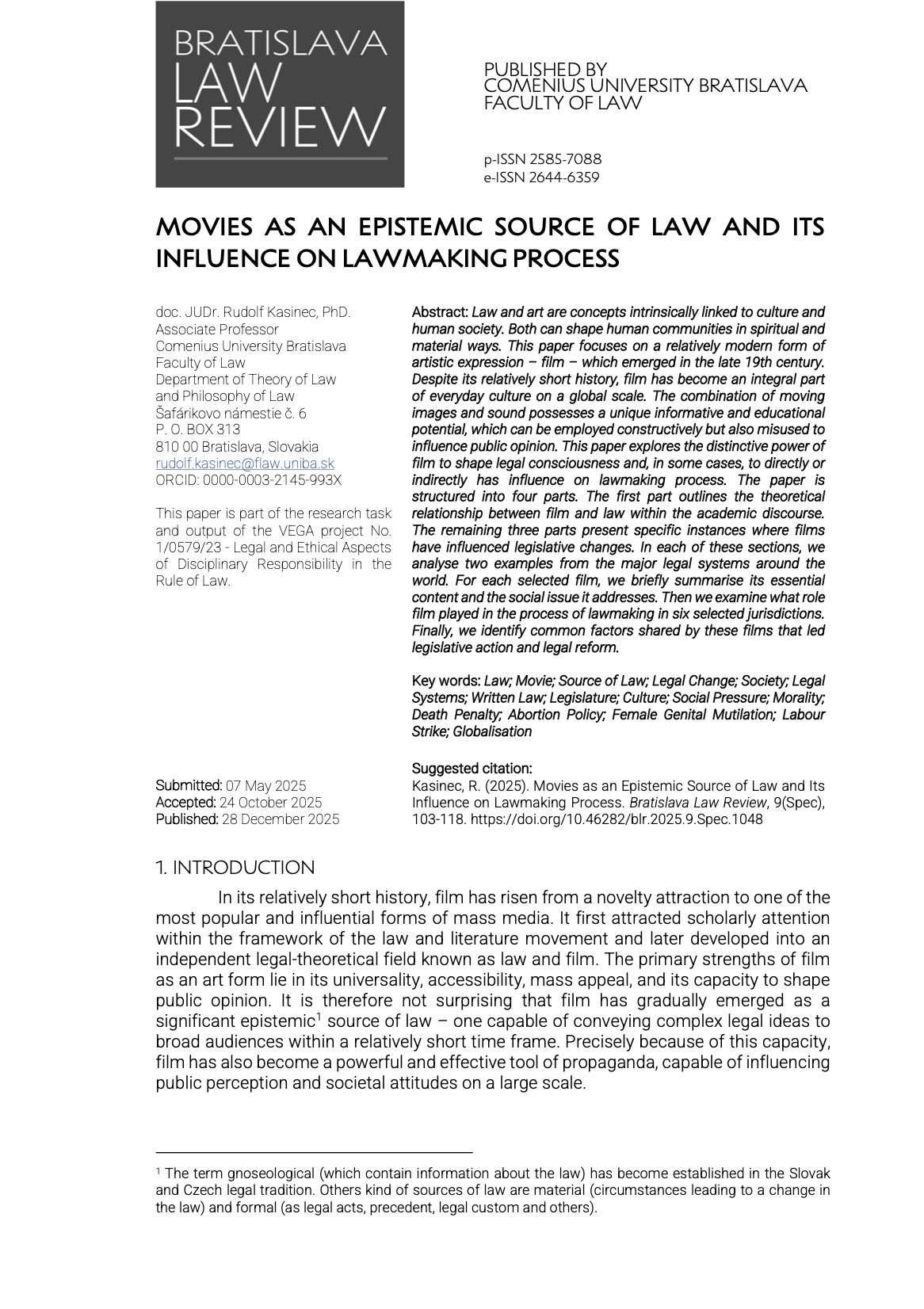
Movies as an Epistemic Source of Law and Its Influence on Lawmaking Process
DOI:
https://doi.org/10.46282/blr.2025.9.Spec.1048Keywords:
Law, Movie, Source of Law, Legal Change, Society, Legal Systems, Written Law, Legislature, Culture, Social Pressure, Morality, Death Penalty, Abortion Policy, Female Genital Mutilation, Labour Strike, GlobalisationAbstract
Law and art are concepts intrinsically linked to culture and human society. Both can shape human communities in spiritual and material ways. This paper focuses on a relatively modern form of artistic expression – film – which emerged in the late 19th century. Despite its relatively short history, film has become an integral part of everyday culture on a global scale. The combination of moving images and sound possesses a unique informative and educational potential, which can be employed constructively but also misused to influence public opinion. This paper explores the distinctive power of film to shape legal consciousness and, in some cases, to directly or indirectly has influence on lawmaking process. The paper is structured into four parts. The first part outlines the theoretical relationship between film and law within the academic discourse. The remaining three parts present specific instances where films have influenced legislative changes. In each of these sections, we analyse two examples from the major legal systems around the world. For each selected film, we briefly summarise its essential content and the social issue it addresses. Then we examine what role film played in the process of lawmaking in six selected jurisdictions. Finally, we identify common factors shared by these films that led legislative action and legal reform.
References
Bahr, B. (2024). Harlan County, USA – Narrative Documentary Production. Available at: https://library.fiveable.me/narrative-documentary-production/unit-10/harlan-county-usa/study-guide/t4Hjgqfoaq8bgLS5 (accessed on 20.4.2025).
Batar, S. (2021). The Impact of Legal Cinema on Ancient Law Reform. Asian Journal of Research in Social Sciences and Humanities, 11(10), 366-371. DOI: 10.5958/2249-7315.2021.00117.9
Bennett, J. (2012). A Short Film About Killing (1988). Prison Service Journal, 199, 13-16.
Biskind, P. (1977). “Harlan County, USA: The miners’ struggle.” In Jump Cut, 14, 3-4. Available at: https://www.ejumpcut.org/archive/onlinessays/JC14folder/HarlanCty.html (accessed on 20.4.2025).
Bond, D. T. (1977). State labor legislation enacted in 1976. Monthly Labor Review, 100(2), 25-38. Available at: https://www.jstor.org/stable/41842043 (accessed on 25.11.2025).
Elsaesser, T. (2019). European cinema and continental philosophy: Film as thought experiment. New York – London: Bloomsbury Publishing Inc.
European Parliament (2020). Female genital mutilation: where, why and consequences. Available at: https://www.europarl.europa.eu/topics/en/article/20200206STO72031/female-genital-mutilation-where-why-and-consequences (accessed on 23.4.2025).
Festa, B. M. (2016). Netflix and the American Prison Film: Depictions of Incarceration and the New Prison Narrative in Ava DuVernay’s 13th. Hungarian Journal of English and American Studies, 28(1), 221-249, https://doi.org/10.30608/HJEAS/2022/28/1/9
Hermann, D. H. J. (1998). The Law in Cinema: An Emerging Field of Study. NYLS Law Review, 42(1), 305-330.
Kamir, O. (2005). Why ‘Law-and-Film’ and What Does it Actually Mean? A Perspective. Journal of Media & Cultural Studies, 19(2), 255–278.
Knauss, S. (2016). Visionary Critique: Gender, Self and Relationship in Rosetta and Two days, one night. Journal for Religion. Film and Media, 2(2), 45-66, https://doi.org/10.25364/05.2:2016.2.4
Mészáros, T. (2018). Právna realita na filmovom plátne Legal reality on the silver screen. Kino-Ikon, 22(2), 272-286.
Meteňkanyč, O. M. (2020). Právo na život a ochranu nenarodených detí verzus právo na súkromie a slobodné rozhodnutie ženy vo veci prerušenia tehotenstva The right to life and protection of unborn children versus a woman's right to privacy and free choice in matters of termination of pregnancy. In Mészáros, T. and Meteňkanyč, O. M (eds.), Právo vo filmovom umení. Osobitná časť Law in film art. Special section (pp. 186-217). Šamorín: Heuréka.
Monaco, J. (2006). Jak číst film: Svět filmů, médií a multimédií [How to Read a Film: Movie, Media, Multimedia]. Praha: Albatros nakladatelství. New York: Oxford University Press.
Mukherjee, T. (2014). Emergence of Cinema as a strong Tool of Social Change. Global Journal for Research Analysis, 3(4), 229-233.
O'Kane, M. and Farrelly, P. (2013). FGM: 'It's like neutering animals' – the film that is changing Kurdistan. Available at: https://www.theguardian.com/society/2013/oct/24/female-genital-mutilation-film-changing-kurdistan-law (accessed on 10.10.2025).
Ostrowska, D. (2010). A Short Film About Killing: Debates on Death Penalty in Socialist Poland. In Riber Christensen, J. and Toft Hansen, K. (eds.), Fingeraftryk: studier i krimi og det kriminelle (Festskrift til Gunhild Agger) (pp. 305-321). Aalborg: Aalborg University Press.
Piturro, V. (2014). Documentary Film Rhetoric: Saving Face and the Public Sphere. Journal of Media, Communication and Film, 2(1), 25-37, Available at: https://iafor.org/archives/journals/iafor-journal-of-media-communication-and-film/10.22492.ijmcf.2.1.03.pdf (accessed on 25.11.2025).
Reichman, A. (2008). The Production of Law (and Cinema): Preliminary Comments on an Emerging Discourse. Interdisciplinary Law Journal, 17, 457-506. Available at: https://ssrn.com/abstract=3561586 (accessed on 25.11.2025).
Saba, P. (1977). 1976 in the Labor Movement: A Year of Activity and Growing Consciousness. The Call, 6(1). Available at: https://www.marxists.org/history/erol/ncm-3/ol-76-labor.htm (accessed on 20.4.2025).
Sherwin, R. K. (2009). Imagining Law as Film (Representation without Reference?). In Sarat, A., Anderson, M. and Frank, C. O. (eds), Law and the Humanities: An Introduction (pp. 241-268). New York: Cambridge University Press.
Silbey, J. (2017). American Trial Films and the Popular Culture of Law. In Northeastern Public Law and Theory Faculty Research Papers Series No. 321. Available at: https://scholarship.law.bu.edu/faculty_scholarship/1385/ (accessed on 25.11.2025).
Sterling, F. (2019). Saving face Viewer’s Guide. Available at: https://www.wmm.com/uploads/2019/02/savface_guide.pdf (accessed on 23.4.2025).
Stok, D. (1993). Kieslowski on Kieslowski. London – Boston: Faber and Faber.
Turčan, M. (2020). Right to life and freedom of choice according to evictionism: Christian critique. Communio Viatorum, 62(2), 184-207.
Wadi (2022). A Handful of Ash: The Campaign to eliminate Female Genital Mutilation in Iraqi Kurdistan. Available at: https://wadi-online.org/wp-content/uploads/2022/02/fgm-brochure_05.pdf (accessed on 10.10.2025).
British Board of Film Classification (1965). Alfie rating. Available at: https://www.bbfc.co.uk/education/case-studies/alfie (accessed on 12.4.2025).
Netflix (2016). 13th. Available at: https://www.netflix.com/sk-cs/title/80091741 (accessed on 10.4.2025).
Section 336A and Section 336B in Pakistan Penal Code. Available at: https://www.na.gov.pk/uploads/documents/1306730721_572.pdf (accessed on 10.10.2025).
The UK Parliament (1967). UK Public General Act 1967 chapter 87 (Abortion Act 1967), Available at: https://www.legislation.gov.uk/ukpga/1967/87/contents/enacted (20.4.2025).
Women’s Voices Now. Handful of Ash Synopsis Available at: https://www.womensvoicesnow.org/films/handful-of-ash (accessed on 23.4.2025).
Downloads
Published
Issue
Section
Categories
License
Copyright (c) 2025 Bratislava Law Review

This work is licensed under a Creative Commons Attribution-NonCommercial-NoDerivatives 4.0 International License.
The Author(s) transfers copyright to the Article to the Publisher of the Journal by the Licence Agreement.
The Author(s) retains rights specified in the Licence Agreement.
The readers may read, download, copy, distribute, print, search, or link to the full texts of all of the Article of the Journal and use them for any other lawful purpose under specified Creative Commons Licence (CC BY-NC-ND 4.0).